
In the world of real estate, there is one phrase that instantly gets a seller’s heart racing: *bidding war*.
It sounds exciting, doesn't it? The idea of multiple buyers competing for your property, driving the price up while you sit back and watch the numbers climb. But if we are being completely honest, the reality of managing multiple offers can feel a lot less like a celebratory auction and a lot more like a high-stakes chess match.
And in some areas they've never gone away. In fact, over the last 60 days in the Beaches neighbourhood, the average home sale price has been consitantly over asking each month in 2026 (up to the date of publishing) signalling many homes sell for over the asking price.
But in Centennial, Scarbororough of the 6 homes sold so far this May, only one house sold over asking on offer night.
If you want to walk away from your sale with the best possible results, you need a strategy that relies on clear logic, not just market hype. Success comes down to understanding exactly how to prepare, how to price, and most importantly, how to choose the winning contract when the dust settles.
1. Setting the Stage: Price is the Hook for a successful bidding war
It surprises a lot of people to learn that generating multiple offers is rarely a stroke of good luck. It is a deliberate strategy. They expect if you just put the price you want and a date to review offers multiple buyers will submit offers. This couldn't be further from the truth!
To get multiple people fighting over your home, you have to price it in a way that creates immediate urgency. This means resisting the urge to test the absolute top of the market with your initial listing price. If a home is priced too high, buyers wait for a price drop, and take their time before they even book a viewing.
By pricing your home at a price that may seem uncomfortably low based on comparable properties in your neighborhood, you open the floodgates. You aren't under-selling; you are inviting the market to determine the true ceiling - moving the people who will 'just try an offer' PLUS the serious buyers to bid against each other.
The added bonus is that you, as the seller are more likely to be able to dictate terms like closing date, deposit amount or few to no contingencies in the process.
What does an uncomfortably low price look like? 10-20% below anticipated sale price.
Managing the Offer Day
Once the buyers are interested, the structure you put in place determines how smoothly the process goes. I like to launch with a specific plan, the home is listed Monday, viewings start that day, 3 open houses are scheduled during the week, and offers are reviewed Tuesday early evening.
During this window, you and your agent have total control over the rules of engagement. You can choose to look at early "pre-emptive" offers if someone tries to buy the home before the deadline, or you can stick to your schedule to ensure every buyer gets a fair shot. The key is setting clear boundaries so buyers know exactly what is expected of them. In our MLS system if you make a change to the listing details (for example to review an early offer, sometimes called a pre-emptive or bully offer - you must notify all potential buyers who have shown interest. That includes all buyers who have had a showing or have an upcoming showing. The MLS listing also must be updated to reflect the date change.
Evaluating Beyond the Highest Number
When offer night arrives and the paperwork starts rolling in, it is incredibly easy to look straight at the bottom line. But a high price is only good if the deal actually closes. As an analytical selling agent, I guide sellers to look at the entire package. A slightly lower offer with no conditions can easily be the superior choice over a higher offer that is packed with clauses.
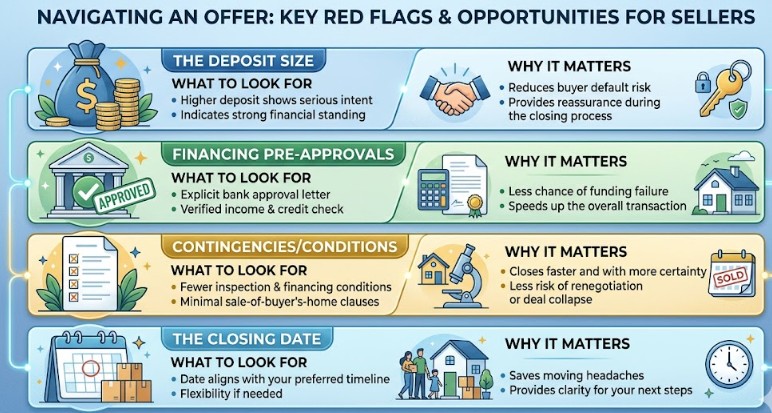
Evaluating Multiple offers during a bidding war
The highest offer on paper isn't always the offer that puts the most money in your bank account. A deal burdened with heavy financing or inspection conditions can fall through weeks later, forcing you to relist your home and lose your momentum.
In fact, I send an email out to any showing agent the day before the offers are due to outline my sellers wants including:
- having the agent include a financial profile of the buyer with details of their down payment, whether they have to sell a property to fund the purchase, their jobs, etc.
- preferred closing date
- "Flow" ie. whether to bring 'best and final' with no chance to change an offer, or whether we will review offers and reach out to some/all of them for changes
Navigating the Next Step
Managing multiple offers requires a steady hand and a deep understanding of human behavior under pressure. When the time comes to make these big decisions, having an experienced partner to guide you through the paperwork and the negotiations makes all the difference.
Always understand the risk
As a seller, you should always understand the risks. Ask yourself: what happens if I don't get the price I'm expecting. What if we get no offers? What happens if we get only 1 offer so there's no leverage? Make sure your realtor goes through those scenarios with you.
What properties do multiple offers work best with right now?
In our unpredictable market, I am seeing multiple offers work best:
- in areas like the Beaches where there is a clear pattern
- for homes that may need 'stacked updates/fixer-uppers' where an irresistable list price may encourage people to remove conditions if they think they can get a deal
- in homes that will have a mass appeal
- in certain price points like first time buyer homes
- in a hot seller's market
What properties do multiple offers NOT work?
- areas where there is a glut of similar housing stock - right now that's 3 bedroom original condition bungalows in Scarborough
- it rarely works in condos or condo towns
- in a 'buyers' market - with lots of inventory
Here are three of the most common, high-stakes questions sellers face during a bidding war.
Q: What happens if we set an offer date and nobody shows up?
A: This is every seller’s biggest fear, but it happens—even in hot markets. If offer day arrives and you receive zero offers, or only one offer that is well below what you expected, it simply means the market didn't buy into the initial pricing strategy.
Don't panic. The next move is straightforward: you pivot. We seamlessly transition the strategy by adjusting the price to reflect a more traditional, transparent market value where buyers can negotiate normally. The goal is to keep momentum moving forward without missing a beat.
Q: Should we accept a "bully offer" before our scheduled offer day?
A: A bully offer (or pre-emptive offer) is when a buyer submits a strong, high-priced bid before your set deadline, usually giving you only a few hours to respond. They do this to cut out the competition.
Whether you accept it depends entirely on how aggressive the offer is. If the buyer is offering a number you would be ecstatic to accept on offer night, with zero conditions, it is often worth taking the bird in the hand. However, if the home has only been on the market for 24 hours and viewings are booked solid, turning it down to let the full market compete is usually the smarter strategic play. I usually discuss this with my sellers and use the language 'we'd consider an irresistible pre-emptive offer'
Q: Can a buyer back out after winning a bidding war?
A: In Ontario, a firm contract is signed under seal, therefore legally binding. However, the real protection lies in the deposit check.
If a buyer wins the bidding war with a "firm offer" (meaning no conditions) but fails to deliver the deposit within the required timeframe (usually 24 hours), the house is still sold. As a seller, you can take the buyer to court to get the deposit which the buyer forfeits as penalty. In the meantime you can sell the home to another buyer. This is exactly why we scrutinize the buyer’s financial readiness on offer night. We love a deposit delivered by bank draft right alongside the offer, so you know the commitment is 100% real before you sign. And that's why we're looking for at least 5% of the offer price as a deposit. Yes, you may need to jump through some legal hoops to get a failed deposit. But who wouldn't like an extra $25,000 or $50,000 on top of selling your house?




